AI Is the Most Dangerous Technology Humanity Has Approached and Bill Gates Explains What Must Change First
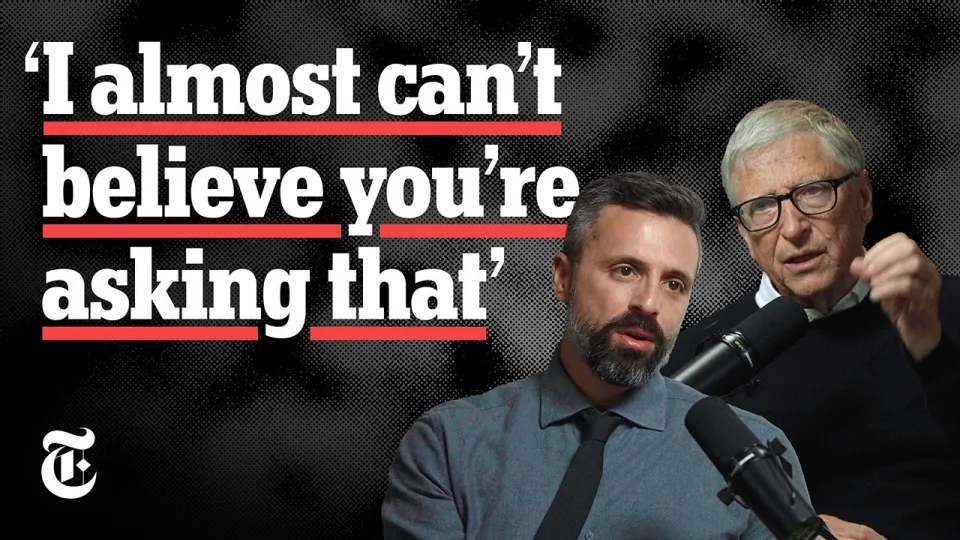
Video: Bill Gates: A.I. ‘Makes Nuclear Weapons Look Like Nothing’ | The Ezra Klein Show
You can order the same kind of articles for your own video to boost it on YouTube and Google. Just message the Telegram bot @sat_sit_bot. The bot writes and publishes the articles itself (with your YouTube video embedded) on popular topical websites (no ads). Try it free: 50 articles on us.
· based on the channel The Ezra Klein Show
Bill Gates argues that artificial intelligence is the most dangerous technology humanity has ever approached, and that the danger is larger than most policymakers admit. In a conversation on The Ezra Klein Show, he says AI "makes nuclear weapons look like nothing" and calls the belief that the AI industry can police itself "insane." The full episode and transcript are available through The Ezra Klein Show page on NYTimes.com.
Gates is not a newcomer to this debate. The Microsoft co-founder spent decades building the software layer that made personal computing ordinary, and he has spent the last twenty years running a foundation that treats global health and poverty as engineering problems. That background is why his shift from cautious AI optimist to alarmed advocate matters: he is describing risks in the language of thresholds, not vibes.
Why Bill Gates says AI makes nuclear weapons look small
The core of Gates's argument is that nuclear weapons, for all their horror, have a narrow set of chokepoints. AI does not. Fissile material is hard to make, warheads are hard to build, and delivery systems are visible to satellites. A model that can write exploit code, design a pathogen, or coordinate a campaign against critical infrastructure requires none of that physical supply chain.
Gates points to two specific thresholds where the risk profile changes qualitatively rather than gradually:
- Cyber. AI systems that can autonomously find and exploit vulnerabilities in power grids, water systems, hospitals, and financial infrastructure, at a speed and scale no human red team can match.
- Bio. AI that meaningfully lowers the skill barrier to engineering dangerous biological agents, turning what once required a trained laboratory into something closer to a search problem.
His framing is that these are not science-fiction scenarios but predictable capabilities on a known trajectory. The question is not whether the technology arrives at those thresholds, but whether institutions are ready when it does.
The self-regulation argument Gates calls insane
Gates is blunt that voluntary industry standards are not a serious answer to catastrophic risk. His reasoning is simple: a company that slows down to be safe loses the race to a competitor that does not, and no board is rewarded for a disaster that never happened.
He reserves particular scorn for the idea that liability and litigation can substitute for rules. If an AI-enabled event kills 100 million people, a lawsuit is not a remedy, it is a press release. Markets price externalities only after they occur, and some externalities are irreversible.
The practical implication is that regulation has to be ex ante and technical, not reputational. That means mandatory reporting of dangerous capability evaluations, licensing or registration for frontier training runs, and independent auditing with real access to model internals rather than marketing summaries.
The US–China race and why unilateral rules fail
Gates treats the geopolitical competition as a constraint on regulation, not an argument against it. If one country imposes strict safety requirements and another does not, the strict country simply relocates its frontier labs and loses the safety visibility it wanted.
The alternative he points toward is coordinated thresholds: agreed definitions of dangerous capability, shared evaluation protocols, and mutual inspection arrangements, modeled loosely on arms control rather than trade policy. That is slow, unglamorous diplomatic work, and it is exactly the kind of work that gets skipped when the narrative is a sprint.
He is also candid that the race framing itself creates pressure to cut corners. Every announcement of a rival's new model becomes an argument for shipping sooner, which is how safety cultures erode without anyone deciding to erode them.
What AI does to jobs, and the case for a no-scarcity labor market
On employment, Gates does not predict a single dramatic collapse. He describes a faster version of what happened to agricultural and manufacturing work: tasks get absorbed, wages for routine cognitive labor compress, and the adjustment lands hardest on people with the least room to retrain.
The policy menu he discusses includes:
- Taxing AI labor. Treating automated output as taxable activity so that the fiscal base does not evaporate as payrolls shrink.
- Human-reserved roles. Explicitly designating categories of work, in care, education, and public safety, where a human presence is required by law rather than by preference.
- A no-scarcity job market. Building an economy where the falling cost of goods and services is passed through to households instead of captured entirely by the owners of compute.
His foundation's new priority is making AI a force for equality rather than inequality, which he frames as a distribution problem as much as a technology problem.
Developing nations, language, and the inequity of distance
One of the sharpest threads in the conversation is about who gets access first. Gates argues that AI could be transformative for low-income countries in health triage, agricultural extension, and education, precisely because it substitutes for scarce professional expertise.
But the same technology can widen gaps if it arrives in English first, is priced for rich markets, and is governed by rules written without input from the places most affected. Language coverage is a concrete example: a model that works well in a dozen languages and poorly in a hundred more bakes existing inequality into infrastructure that will be hard to replace later.
Gates's line about inequity being permitted because of distance cuts both ways. Distance has historically let wealthy societies ignore harms elsewhere; AI compresses that distance without necessarily compressing the indifference.
Children, education, and the rules that come next
On education, Gates is more optimistic than on jobs, but not uncritically. He sees genuine gains in tutoring, feedback, and access for students who cannot afford private instruction, and he also acknowledges the learning loss that rich countries have struggled to reverse.
His regulatory instinct for children is stricter than for adults. Age-appropriate design requirements, limits on persuasive and emotionally manipulative systems, and default protections rather than opt-in parental controls are the kinds of measures he treats as obvious rather than radical.
Common questions about Gates's AI warning
The most frequent pushback on this argument is that alarmism has a poor track record. Gates's response is that the burden of proof has flipped: the people claiming a general-purpose system capable of autonomous action is safe by default should have to demonstrate it, not the other way around.
A second recurring doubt is whether regulation can keep pace with model releases measured in months while legislation moves in years. The partial answer is that technical standards bodies can move faster than parliaments, and that compute itself is a chokepoint regulators can actually see, unlike data or algorithms.
A third is whether Gates, given Microsoft's stake in OpenAI, can speak credibly about restraint. He addresses the conflict directly rather than dodging it, which is more than most industry voices manage.
Useful links
The bottom line on Gates's AI warning
Gates's position is not that AI should be slowed to a crawl, but that the current approach, ship first and negotiate later, is a bet with a tail risk nobody has priced. He wants hard thresholds on cyber and bio capability, real audits instead of self-reporting, and international coordination before a crisis forces it. The Ezra Klein Show conversation is worth reading in full because the disagreements are substantive rather than theatrical, and the transcript at nytimes.com captures them without editing out the friction. Whether or not you share his alarm, the specific mechanisms he names are the ones any serious AI policy will eventually have to address.
Key takeaways
- Bill Gates calls AI the most dangerous technology humans have ever approached, saying it makes nuclear weapons look like nothing.
- He names two hard thresholds where risk becomes catastrophic: AI capable of mass cyberattacks and AI that can help engineer bioweapons.
- Gates says the idea that the AI industry can self-regulate is insane, arguing lawsuits cannot answer an event that kills 100 million people.
- He frames the US–China AI race as a reason regulation must be coordinated rather than unilateral.
- The Gates Foundation is set to spend roughly $200 billion over the next two decades, with AI and equality named a new priority.
Questions & answers
What exactly does Bill Gates mean when he says AI makes nuclear weapons look like nothing?
He means the barriers that constrain nuclear risk, such as scarce materials, visible facilities, and a small number of state actors, do not apply to software. A sufficiently capable model can be copied, run anywhere, and used by almost anyone, so the risk scales with capability rather than with physical supply chains.
Why does Gates reject industry self-regulation for AI?
Because competitive pressure punishes restraint. A lab that voluntarily slows down loses ground to one that does not, and liability arrives only after harm that may be irreversible. He argues for mandatory pre-deployment evaluations, independent audits, and licensing of frontier training runs instead.
Is Gates arguing that AI development should be paused?
No. He treats the technology as too valuable to stop, especially for health and education in low-income countries. His argument is about sequencing: build the safety thresholds, evaluation regimes, and international agreements before capabilities cross the cyber and bio lines, not after.
How does the US–China competition fit into his view of AI regulation?
He sees it as a reason for coordinated rules rather than unilateral ones. If only one side imposes strict requirements, frontier work migrates and safety visibility is lost, so agreed definitions of dangerous capability and shared evaluation protocols matter more than national legislation alone.
Source: Bill Gates: A.I. ‘Makes Nuclear Weapons Look Like Nothing’ | The Ezra Klein Show · Markdown version